Tuesday, June 19, 2007

中国挑战 - 电视新闻 (TV News, Weina Betty Sun)


《中国的挑战:一个新猜想》

—— 对"中国挑战"说的一个注释


"我们能从中国人没有教我们的地方学到什么?"

——鲁道夫


主流文化依赖于书写模式。

民族的理性特质、他们的技术有效性、他们把社会组织起来、交流信息、以及
他们的艺术科学等等这一切都跟书写模式分不开;人
们在书写和创建自己作为典籍的文化实践中学会思维和生活。

主流文化总是依赖于某种书写里包含的理性和技术模式。一

般来说,书写是一种文化、政治和技术形成的最抽象的机制和技术

——欧洲的文化及第一次猜想

欧洲的文化依赖于字母书写和印度的零占位机制,这种机制使得算术、计算的经济合理、形
式化和编程语言成为可能。

莱布尼茨提出第一个关于中国文字的猜想。
他设想了一种"通用语言 作z为国家和人民之间沟通的可信赖的通信基础。

他的这个想法类似于中国的象形文字,
中国象形文字通过典籍在不同口头语言之间起着桥梁作用。

要实现这一梦想他发明了凝练的数字表示和计算系统,这就是二进制系统,依此
作为欧洲对古老的中国"易经 "的一个回应,
最终他发明了独立于任何民族语言的运算方法和逻辑,还有作
为计算机的原型的计算机器。

现代欧洲科学技术遵循了莱布尼茨的想法,产生了技术上的二进制主义和数字主义,并形成
了今天西方——以及亚洲——的基本技术和经济力量。

但是,欧洲的技术力量停留在"老欧洲"的意识形态、形而上学和伦理学框架和限制当中。
——美国的美式梦想

在美国,欧洲的思维和技术形式摆脱了她的形而上学老套子,发明了"无所不在的计算",实
现了人工智能,人工生命,认知系统,机器人等等;实
现了无限扩张的数字主义

今天,美国的美式梦想气数已尽!

美式梦想的成功已经接近了尾声;而老欧洲还由她的古希腊起源支配着,
摆脱了欧洲限制的美式梦想现在迷失了根本,失掉了设计未来的精神源泉。

美国的必然衰落是由于"无根"!

与欧洲分道扬镳,成了无本之木无源之水,在数字主义达到了她的颠峰。


在沉湎于"数字形而上学" 中并归结为0和1的不朽精神世界中,展望
更先进的科技发展似乎是不可能的了。

全部美国式发展会在"数字实用主义"世界观中固步自封!

所以,基于古希腊字母文字、印度的数论和莱布尼兹采用中国文字模型,这
一切作为欧洲和美国的美式梦想失去了设计世界未来发展的力量。


——中国书写模式

中国没有发展出类似的哲学 、科学 和技术 ,这是因为她的超复杂的书写模式,
现在正在采用西方的科学技术成果;
但是,中国在下一个时代自有对西方的优势:有没有被开发的丰富典籍资源。

中国文字永远是她的文化和政治的基础和保证,没有"字母线性主义"和数字主义的限制。
西方思维 的线性性质是更容易映射进入中国理性的"表格样式"的。

这种映 射过程,在中国文字的自明性质方面不会导致任何混乱。


中国文字概念是表格样式的、多维度的、嵌入式的、开放的、复
杂的和基于民族最古老文化传统的。

而这些特征正符合科学技术在处理现代社会问题和开创新未来的要求的。

因此,为今而言,所谓中国的挑战,不是为西方视为危惧的新的经济实力和经济扩张,而
是在作为未来技术革命基础的中国理性重新发现的可能性方面。


中国理性把任何美国式的东西远远地甩在了后面。中国对西方的挑战不是经济的、
也不是政治的或者军事的;

苏醒的技术中国和经济中国这个事件并不构成对西方的所谓的"大挑战",
真正的挑战是重新发现她的文字系统,并设计出新的理性形式系统,
就像创造新的数学和新的编程语言一样;


是面对一个崛起的中国我们是否做好了充分的准备。

因为忙于适应西方的技术和经济,
中国官方还没有意识到这种形成未来主流文化基础的可能性。
可能吧,十九世纪是欧洲世纪,二十世纪是美国世纪,
而二十一世纪将是中国世纪。


——形态语法学:第二个猜想


我的想法作为后欧洲的第二个关于中国文字的猜想由此而生。
第一步,我提出"多结构逻辑(Polycontextural Logic)"的研究和
"形态语法学(Morphogrammatics)"研究,作为在西方模式走到尽头时,对
中国理性和技术的概念系统作的一个可能的、新的理解。这

一工作——我知道它的风险——是某种实验性的猜想,具有永恒自解构的能力,超越西
方、亚洲在思维和技术方面的"具象中心主义",形而上学的单一结构主义。


形态语法学和多结构理论包含并且超越西方的思维、计算和编程语言的设计,能够
满足新时代对操作理性提出的表格样式 的处理和对复杂性处理的要求。

猜想总是文化传统革命的前奏,总是为文化管理者所拒绝。


作者:Rudolf Kaehr
翻译:韩宪平
来源:思维实验室
网址:www.thinkartlab.com


《中国的挑战:一个新猜想》Chinese Challenge-TVNews

Monday, April 09, 2007

The Chinese Challenge Video-Stills


《中国的挑战:一个新猜想》

The Chinese Challenge

—— 对"中国挑战"说的一个注释

Hallucinations for Other Futures

Donna and Shell


我们能从中国人没有教我们的地方学到什么?

What can we learn from China that China is not teaching us?

Europe is lost in its search of the dying and buried roots in Greek heritage.


我们能从中国人没有教我们的地方学到什么?

What can we learn from China that China is not teaching us?

今天,美国的美式梦想气数已尽!


Today, the US-American dream is exhausted!

今天,美国的美式梦想气数已尽!


美式梦想的成功已经接近了尾声;而
老欧洲还由她的古希腊起源支配着,摆脱了欧洲
限制的美式梦想现在迷失了根本,失掉了设计未来的精神源泉。


While Old Europe is still occupied with its Greek roots,
US-America, who got rid of these
European limitations,
now, is missing roots as inspirational resources to design futures.

The necessary decline of America is rooted in its lack of roots.

Today, the US-American dream is exhausted and has come to a closure.

The Chinese Challenge to the West is the re-discovery of a
new way of thinking, again


中国对西方的挑战不是经济的、也不是政治的或者军事的;苏醒的技术中
国和经济中国这个事件并不构成对西方的所谓的"大挑战",真正的挑战是
重新发现她的文字系统,并设计出新的理性形式系统,就像创造新的数学
和新的编程语言一样;是面对一个崛起的中国我们是否做好了充分的准备。


The Chinese Challenge to the West is not economical, political or military.

It is not the event of a re-awakening economic and technological China which is the Grand Challenge to the West but the possible re-discovery of the operationality of its writing system for the design of new rational formal systems, like new mathematics and new programming languages.

China has found its roots again to build a future.
China’s historical advantage to the West is that its scriptural
resources are not yet exploited.


中国挑战向中国将保存它自己的文化在与人类一个新世纪的转折过程中。

它怎么可能做? 我们
How can it be done?
let's do it!
The Chinese Challenge to China is to preserve her own culture in
the process of the transition to a new epoch of humanity.


它怎么可能做? 我们做它!
How can it be done? Lets do it!

它怎么可能做? 我们做它!

它怎么可能做? 我们
How can it be done?

我们做它!The Chinese Challenge to China is the chance to re-discover its
own
way of thinking, again.


let's do it! 我们做它!

我们做它!

Hallucinations always had been at the beginning of cultural revolutions.
It always has been the job of cultural administration to deny it.

猜想总是文化传统革命的前奏,总是为文化管理者所拒绝。
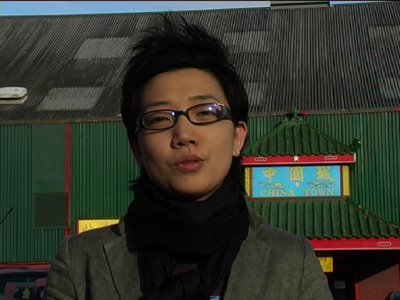
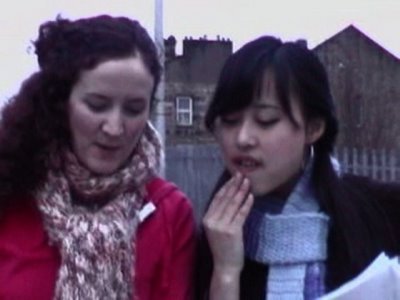
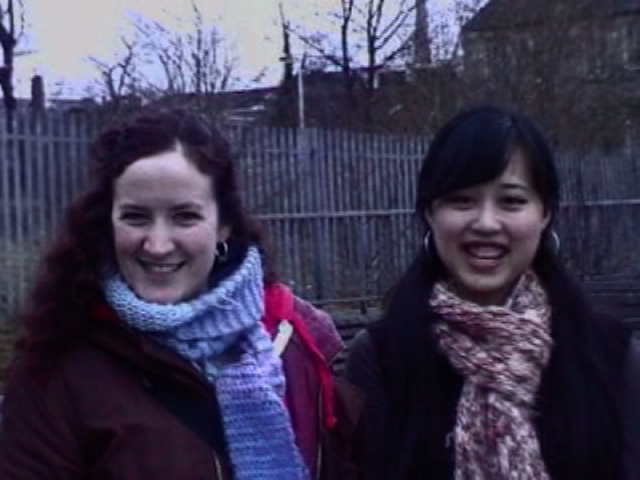
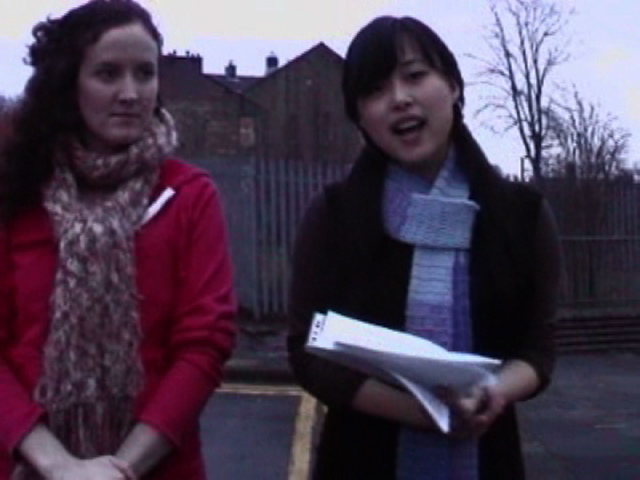
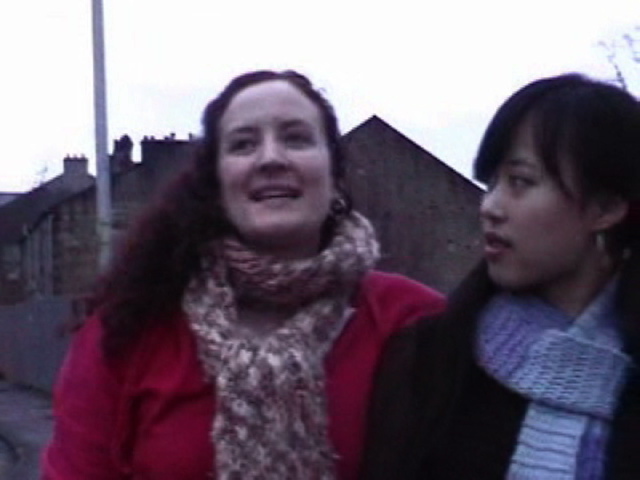
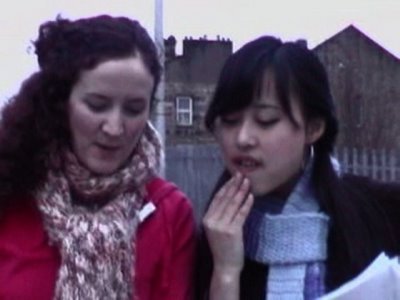
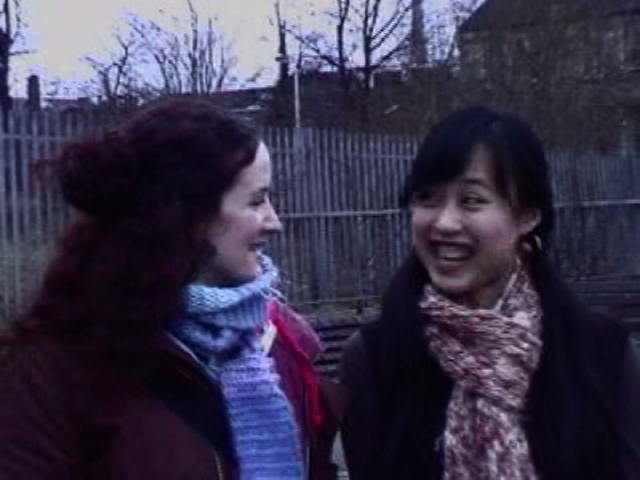
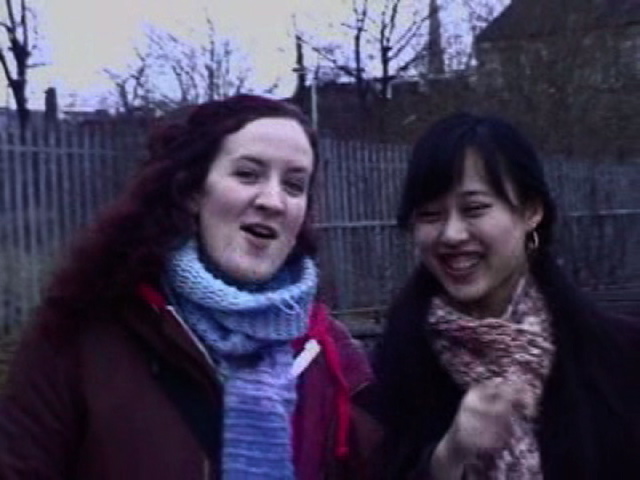
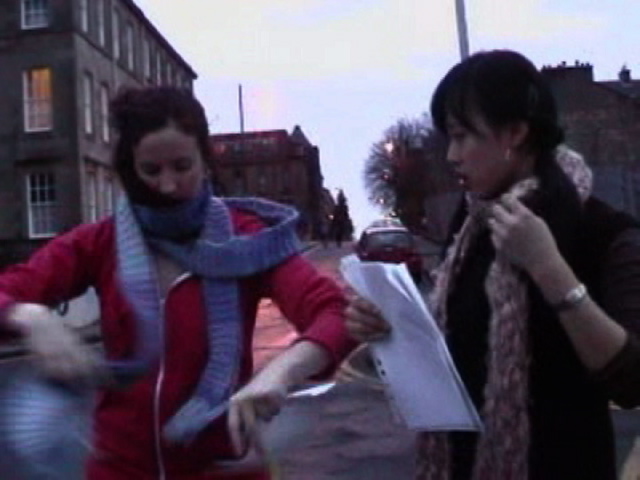
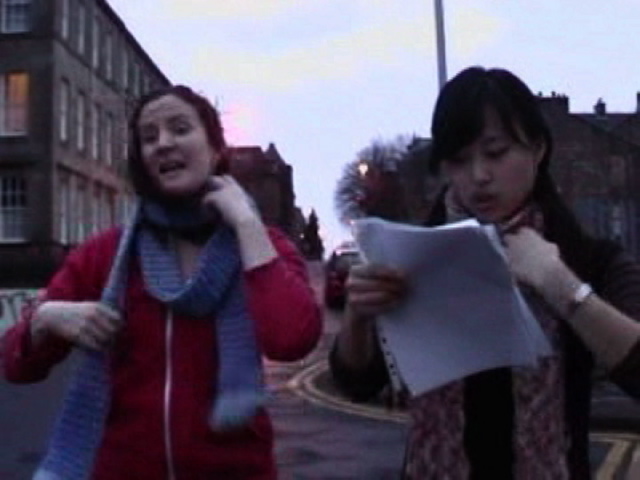
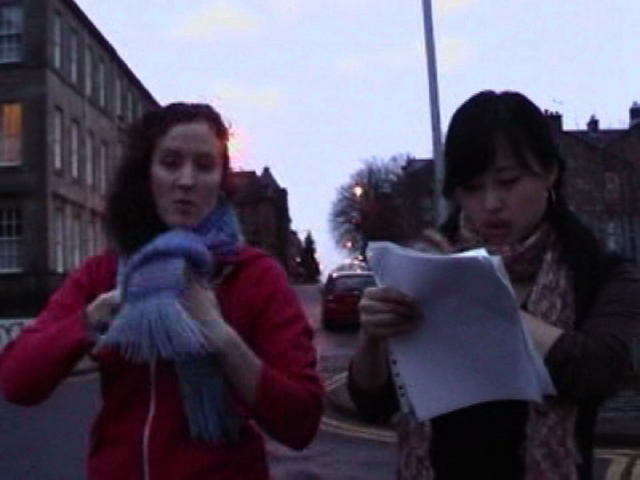
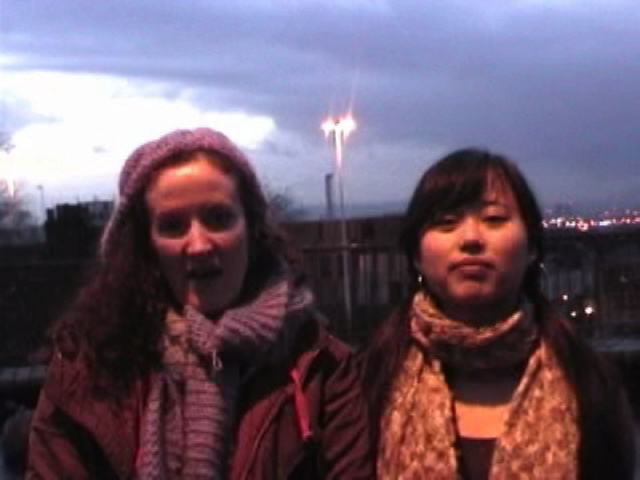
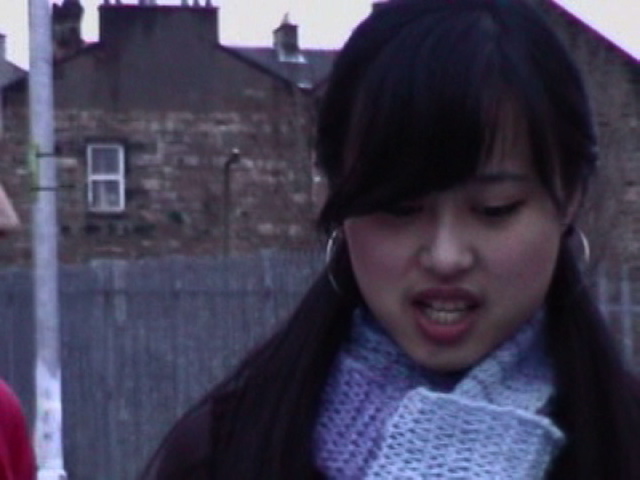
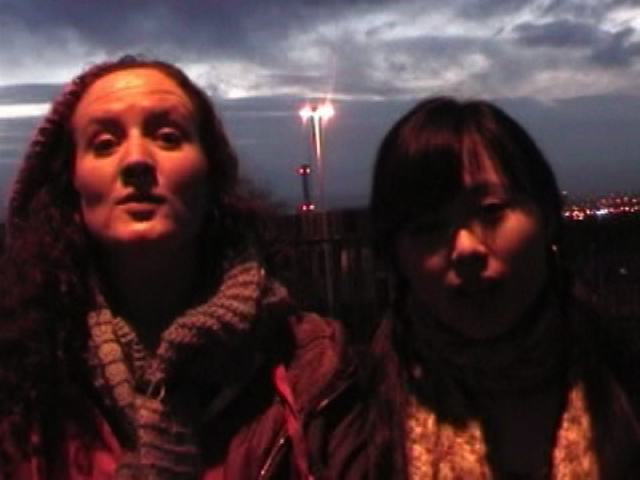
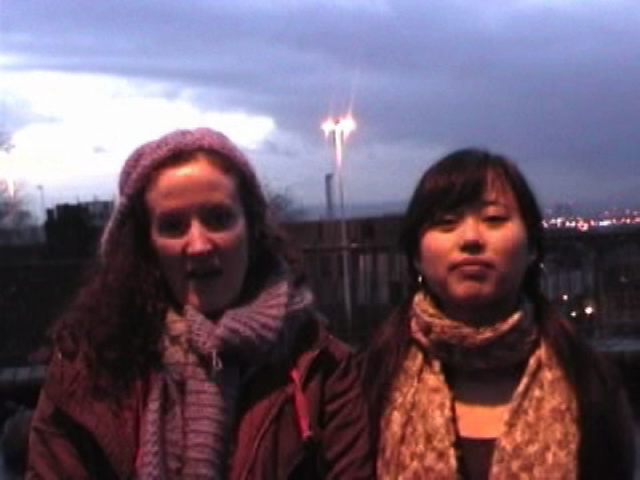
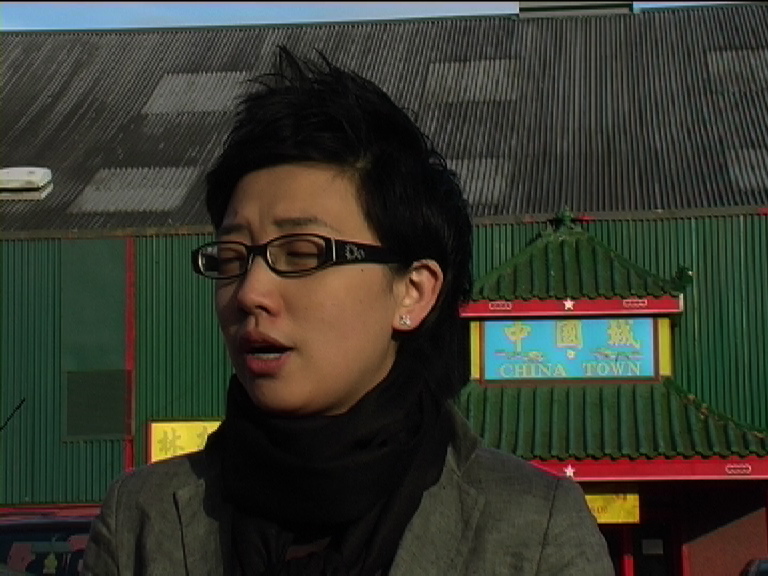
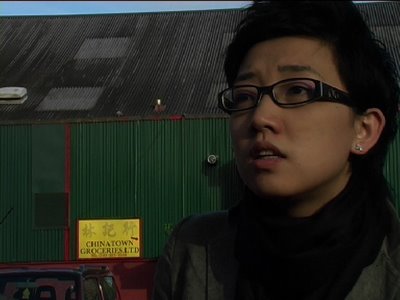
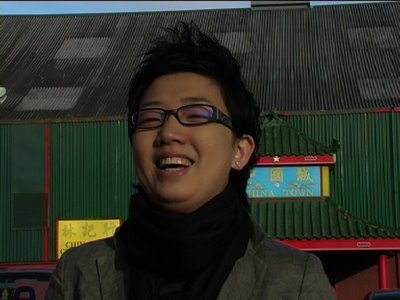
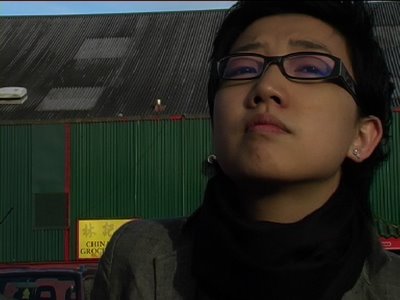
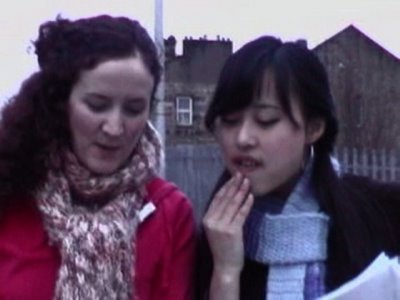
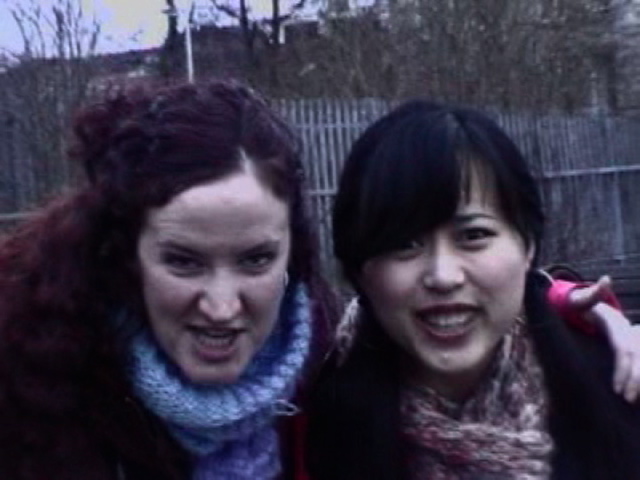
Stills from the Video "The Chinese Challenge::中国挑战" about an idea of the new role of China and Chinese thinking beyond economical, political and military matters in English and Chinese by Shell Ni (film maker, Shanghai/London) and Donna Rosso (actress, Ireland/Glasgow) recorded spontaneously by me, holding the wee camera into the air, at a dark Sunday afternoon at the Garnethill/Glasgow viewpoint, edited by Ann Vance (film maker, Glasgow).
http://www.youtube.com/watch?v=jCNcFmPl-9E

Thursday, March 29, 2007

Proto-Structure of Diamond Strategies

„Everything is true: not everything is true; both, everything is true, and
not everything is true; or, neither everything is true nor is everything not true.
This is the teaching of the Buddha.“ Madhyamika Karika

Beyond names and propositions, again
Without getting lost into the deepness of philosophical and grammatological studies we can apply the mechanism of proto-structure, i.e., the activity of tetraktomai,i.e., to use the tetraktys, on a more common arena of emotive-cognitive organization in communicational situations. The Diamond Strategies are obviously operating beyond notions and statements, thus, if applied in therapeutic situations, they are not primarily a "talking cure" (Freud).

Our orientation in the world is mainly guided by sentence/notion based thematizations. To diamondize, like to tetraktomize, is to abstract and to subverse this semantic level of thematization in favor of its dynamic patterns, i.e., the morphograms of interaction/reflection of communication.
The process of morphic abstraction is pushed by questioning the existence (ek-sistenz, Heidegger) of the communicand (client).
The existence is what can be abstracted from the historic and local stories of the person involved. But such an existence is not identical with an identical kernel of a self or ego of a person(a) (mask).

In Ancient time of Pythagoras and the Chinese and Indian thinker, this procedure was not an abstraction but the genuine and direct way of approaching reality.

In a form, reduced to logocentric purposes, the diamond is well known in the West since Aristotle as the Square of Oppositions, and it had many modern applications in logic (Belnap, Fitting), psychology (Piaget), semiotics (Pierce), linguistics (Greimas), etc. Today general studies of the "Square of Oppositions" are promoted by the Universal Logic group which is running its 2nd World Congress at Xi'an, China.
Obviously, the Diamond Strategies are not excluding such logical studies of the Square but are not to gather under their umbrella.

There are many existential and emotional strategies today to defend ones established attitudes against a new way of thinking and thematizing the world.
One is well documented in the Gödel-Günther-Correspondence.
To overcome such barriers, the Diamond Strategies always had been of great help.

Proto-Structure of the Diamond Strategies

Also deconstruction is not simply a method, Derrida gives us some general strategies of deconstruction.

Reversion of hierarchy
"In a traditional philosophical opposition we have not a peaceful coexistence of facing terms but a violent hierarchy. One of the terms dominates the other (axiologically, logically, etc.), occupies the commanding position. To deconstruct the opposition is above all, at a particular moment, to reverse the hierarchy." (Derrida, Positions, 56-57).
The double gesture displacements
"Deconstruction must through a double gesture, a double science, a double writing, put into practice a reversal of the classical opposition and a general displacement of the system. It is that condition alone that deconstruction will provide the means of intervening in the field of oppositions it criticize and which is also a field of non-discursive forces." (Derrida, Marges, 392)
Interestingly, the Diamond Strategies are incorporating both Ancient attitudes:
1. The tetralemmatic and tetractic way of conceiving truth (Buddha, Pythagoras), and
2. the pragmatic or praxeological apraoch of Chinese thinkers to the relevancy of statements as opening futures instead of claiming eternal truth.

Let us play the game of the Diamond Strategies

From the frozen attitudes of our hierarchical thinking and feelings to the endless flow of inventing and co-creating our futures in the open chiasm of systems of multiple opposites.


Step one: Position (Problem, Conflict)
Describe your state or situation of the moment with a good, short but precise statement. It´s your statement of position, affirmation, it´s your starting point of the game.

Question1: What is the situation/constellation you want to explore/re-solve?

Go with your personal starting statement as deep as possible into your emotional and/or cognitive state. Ask yourself about your state formulated in your first starting statement. Elaborate the semantical and emotional context of this statement. Take your last/best sentence of your exploration of your feelings and thinking of your situation and write it down.

Step two: Opposition (Subversion, Solution)
Create the opposite of your state, of your belief statement, of the sentence which describes your situation most concrete.

Question2: What is the opposite of your starting position?

Our language gives us a lot of possibilities to build opposites: logic, grammar, semantics, word games, phonetics, writing, gestures etc. It´s not only negation, you also have inversion of all sorts of order in a sentence or between sentences, dualities, reflections, mirroring and many other methods of translating a statement into it´s opposites.

Example
Position: Nobody loves me.
first opposite: Everybody loves me.
second opposite: Everybody hates me.
third opposite: Everybody loves you.

I would like this one as a nice opposite of "Nobody loves me." :: "I love anybody."

What are the connections between the position and the opposites? You are discovering a Semantic Field of statements between position and its oppositions.

Third step: (neither-nor-): sovereignity
Change between your two states (position vs. opposition). Take position and all feelings for the one, and then take all feelings and surely also all thoughts for the other one.

Question3: What's your neither-nor of position/opposition?

Change and feel what happens when you are changing from position to the opposite. Play this transition game as often until you feel and think that both are equivalent (like light/shadow). Then you will feel immediately that you are free from both: you are not the one and not the other.

You as a subject, as a person you are neither this nor that. This insight and this feeling, that you are not identified with one of the sides of the opposite is your third position. Here you are free, you have the most possible distance to all of the world. Then, how do you see the two other positions, how do you feel them? Go back to the first and to the second. Which do you like most? Play the game until you feel all three positions as equally relevant. All three belongs to you.

Fourth step: all of that at once - pure richness
But this is not all we can do. We can also have the opposite of this distance and sovereignty of the 'neither-nor'. It is the fourth position of 'both-at-once'.
Now you have often changed your positions and you had have very strong feelings and insights in this three positions and transitions. You will discover that all this belongs to you. And not only one after the other but all at once. You are all that at once. You are both position and opposition.

Question4: What is your both-at-once of position/opposition"?

Re-Solution
Then you make the complete trip: you go around the 4 positions in at least 6 primary steps, you have 24 permutations of your primary steps- that's your universe of experience(s) at this very first step within the Diamond Strategies.

Exploration
Each station of the Diamond elaborated serves as a new starting point (Position) for further diamondized explorations of your complex emotional/cognitive space.
With the game of the Diamond Strategies you have deliberated yourself from your fixation on one point of view in describing, reflecting, feeling, deciding, organizing etc. your life, your future of your organization or company.

Opening existential futures: Enabling vs. disabling

All of the four positions of the first Diamond Strategies can be asked about the future possibilities, about their perspectives, about their horizon of new behaviours, etc.
You can ask: What enables me this, which are the new possibilities for me, what new chances are opened up by this state, position etc. for me.

First Step: Enabling vs. disabling
Take one of the 4 positions of the Diamond, then ask one of the questions about enabling/disabling.
1. What is the position enabling/disabling,
2. What is the opposition enabling/disabling,
3. The neither–nor– of enabling and disabling,
„What neither enables nor disables me A?“
4. The both–and– of enabling and disabling,
„What both at once enables and disables me A?“

Second Step: Iterations
You can also freely repeat and alternate your questions about enabling and disabling, thus producing a grid of enabling/disabling positions.


Diamond Strategies of Thematizations

After the more existential application of the Diamond Strategies we are applying them onto the linguistic and grammatological situation of notion/proposition.

Designing the Diamond
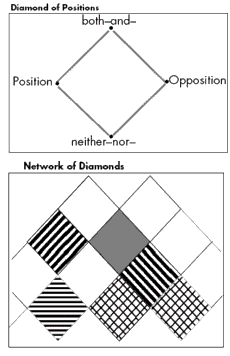
A possible Diamond of notion/sentence can be established as:
Notion: name-based conceptualization,
Proposition: proposition-based thinking,
Morphogram: neither name nor proposition,
Inter-textuality: both at once, name and proposition.


Iteration of the Diamond
notion–––>proposition–––>notion

Accretion of the Diamond
proposition as position, new opposition could be text.
morphogram as position, new opposition could be image.
inter-textuality as position, new opposition could be medium.


The diagram shows a possible accretion of the first diamond. There is no strict necessity to develop the diamond this way, other decisions for an interpretation of the knots can enter the game, producing other interpretations of diamonds.
Diamondize vs. Syllogisms
Trees are graphic representations of the notional entailment relation which is at the base of logical thinking, deduction, not restricted to Aristotelian syllogism only.

It is of importance to understand that such an accretion is not building a subordinating order, like a diaeresis, thus, it is not a pattern founding deduction, syllogism and linear or tree-like conceptualization. The knots of this diamond, understood as a proto-structure, can be themselves starting points, origins, for binary trees.

Because of its commutative structure, the graph of the proto-structure is a grid and has neither an origin nor an end. Thus, it might be slightly misleading to write the proto-structure with a beginning (1:1) as it is presented in Gunther’s papers. This happens for notational purpose only.

Neolithic Incisions

Excursion: Some early orientational systems
At a time of human development, long before the advent of names, notions, sentences and numerals, and images too, there had been incisions, structuring the orientation in the world and co-creatively enabling the advent of human beings.

It is the work of the archeologist Marie König to have discovered those early incisional systems.

Interestingly, most of the basic patterns are at place.
Diamonds, grids, circles, points, and systems of different patterns.
Not necessarily binary trees?


It seems obvious to understand these patterns
as cosmic orientation systems. And obviously not being connected to cognitive and linguistic units, like propositions, names, numbers and images, despite their importance, probably, as the very first orientational writing systems.
"Erst die griechischen Naturphilosophen verurteilten die Auswüchse des mythischen Denkens. Sie begannen, ein neues Bild vom Kosmos zu entwerfen und leiteten damit eine neue geistige Entwicklungsstufe ein. Diese Zeit wird gern als der Anfang des europäischen Denkens angesehen, im Gegensatz zum mythischen Denken, das unwissenschaftlich, ungeistig und unrealistisch zu sein schien. Weiter als bis zur Mythologie reichte weder das Gedächtnis der Menschheit noch das Zeugnis der Schriftquellen zurück, und man suchte den Anfang der Kultur dort, wo die Schrift begann, also in den orientalischen Hochkulturen, die in Wirklichkeit einer hochentwickelten geistigen Entwicklungsstufe zuzurechnen sind. Damit verlor unsere Kultur eine Dimension der Tiefe. Wir hatten unseren geschichtlichen Ursprung verloren." (presented by Esther Keller-Stocker) http://www.theologie-vision.eu/bewusst/marie_koenig/koenigII.htm
Marie E.P. König: Am Anfang der Kultur, Die Zeichensprache des frühen Menschen, Gebrüder Mann Verlag Berlin 1973.


["Not until the Greek ancient philosophers condemned the excrescences of mythical thinking. They began to sketch a new picture of the cosmos and introduced with it a new spiritual stage of development. In contrast to the mythical thinking, which seemed to be unscientific, unspiritual and unrealistic, this epoch is regarded gladly as the beginning of European thinking. As up to the mythology neither the memory of mankind nor the testimonial of the sources of writing continued to go back, and one looked for the beginning of culture, where the writing began, thus in Eastern advanced cultures, which in fact are part of a highly developed spiritual stage of development. Thus our culture lost a dimension of profoundness. We had lost our historical origin."]

Chinese Centralism?

Beyond propositions, names, numbers and advice

"But what has still not been seriously investigated in modern linguistic analysis during the course of secularization of myth, religion, and metaphysics is the increase of secularization on human language. In its insect like persistence, in which it naively supposes that Man and not the universe as a whole is the proper subject of speech and thought, it has completely forgotten God and myth, which both await their metamorphosis." G. Gunther

Summary
The question arises: Is there any rational structure beyond name- and sentence-oriented thinking?
Or: Is there a rational operativity beyond alphabetic sign systems?

In an idealized form, both, name- and sentence-based thinking, are depending structurally on trees. Well known as binary trees of diaeresis or Porphyrian trees. Today as XML trees. The same holds for generalized sign systems, i.e., semiotics. But today, the tree model of organizing knowledge is producing more problems than it solves in complex computing.

Post-modernism has hallucinated the metaphor of net or rhizomatic writing, but didn’t provide any operativity to be useful for real world problems, like programming. Media theorists are fantasizing about the structure of the Web as decentralized, open, complex, heterarchic and not hierarchic at all. They are lost in the chaos of surface-structures, not being able to recognize the strong and strict mathematical centralism and hierarchic organizational order of the Web’s deep-structure.

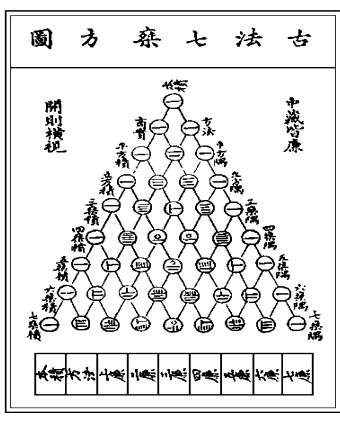
The acceptance is slowly growing that pre-modern thinking of Pythagoras in the West and Ancient Chinese is neither name nor sentence guided, hence not to be organized by any tree structure. How could such a structure look like? The simplest structuration of Ancient thinking can be supposed as a pre-semiotic proto-structure, realized in history by a triangle model, i.e., a commutative graph, by the Ancient (Pythagoras, Yang Hui, later Blaise Pascal). Each knot of a triangle model is over-determined and therefore logically contradictory.

This structure was re-discovered by the Western thinker Gotthard Gunther for the purpose of mediating number and notion as well as thought and will and exposed in his theory of polycontexturality and kenogrammatics. The proto-structure is offering a devise to distribute and mediate a multitude of binary trees and studying their interactivity and reflectionality in an operative and computable way. A similarity between such a distribution of binary trees over the proto-structure and on the other side, the multitude of spoken Chinese languages and their common scriptural system is proposed.

It is my experience that there are strong existential and emotional defence strategies and barriers which are preventing people from learning about such ways of pre-semiotic thinking. Thus I introduce a format to deal with such anxieties: The Diamond Strategies.
Surprisingly, the Diamond Strategies are in a good correspondence and harmony with Ancient Indian and Chinese formats of thinking and acting as well with Gunther’s concept of proto-structure.

Of the many practical applications possible, only one question is proposed, re-opening a new round of thinking the Chinese Challenge aiming to surpass the common Double Blind Spot:

Can the Chinese Centralism be the same as the Western?


1. Name-oriented languages

Modern linguistics as the study of sign and languages systems in general, has to be separated from the philosophical decisions to focus on certain language interpretations, like the noun-, proposition-, action-oriented understanding of language. The aim of this study is to make some steps toward a reasoning beyond such decisions for propositions and their hierarchy (diaeresis) in favor of a new way of orientation and computation guided understanding of thematization and symbolization by the decision for polycontexturality and kenogrammatics.

Chad Hanson writes about the linguistic analysis of Chinese language by Chinese thinkers.
"Chinese linguistic thought focused on names not sentences."
"This explains the anomaly of treating all terms as 'names,' but fails to explain the similar treatment of adjectives and verbs. Lack of function marking is again part of a possible explanation. Adjectives used in nominal position did not undergo abstract inflection so theorists treated 'red' and 'gold' as analogous. They could associate descriptive adjectives, like mass nouns, with a range or "extension" and view adjectival "names" as distinguishing one range from others. The ranges distinguished by different "names" can overlap. In those cases, they would use compound "names." Distinguishing between the ways adjectives and nouns worked in compounds produced puzzles for pre-Han theorists."

"Zilu said, ‘The ruler of Wei awaits your taking on administration.
What would be master's priority?’ The master replied,
‘Certainly--rectifying names!’ . . . .
If names are not rectified then language will not flow.
If language does not flow, then affairs cannot be completed.
If affairs are not completed, ritual and music will not flourish.
If ritual and music do not flourish, punishments and penalties will miss their mark.
When punishments and penalties miss their mark, people lack the wherewithal to control hand and foot.
Hence a gentleman's words must be acceptable to vocalize and his language must be acceptable as action.
A gentleman's language lacks anything that misses--period.(13:3)"
http://www.hku.hk/philodep/ch/lang.htm

A chain of terms is build: rectification/names –> language –> ritual/music –>
punishment/penalties –> control
==> acceptance of vocalization/action.

This chain of terms, from rectifying names to the acceptance of vocalization and action, suggests a linear and hierarchic order of entailments. There are no chiastic elements or relations involved. But there is also no system mentioned in which the hierarchic development takes place. Thus, it is open to interpretations.

Cyclic and chiastic order
If, on the other side, it is said, that "war becomes peace and peace becomes war" (Confucius, Heraklit) a cyclic and chiastic (dialectic) order is established. What is basic in this approach are not the names and notions involved but the rules of the interplay between them. This chiastic model, even still archaic, is neither sentence- nor notion-based. The change, the differences of the play are primary to the notions involved. Because of its chiastic form, the whole statement is in itself also not strictly a sentence or proposition in the definitional sense. Because a sentence is based on the hierarchy of subject and predicate.

Chiastic forms are circular, violating the hierarchy of propositions. Thus, the operator "and" is not simply a logical or linguitic conjunction but a term for mediation between the two order relations between war and peace. There is no reason to thematize chiastic formations as name-based. This change as such is neither name- nor proposition-based, but a chiastic interplay between the terms.
In the terminology of polycontextural logic, this situation is modeled by the proemial relationship.

2. Thought, will and numbers

Name/proposition/contexture or sign vs. kenogram
Before the digitalists have overtaken Western ideology, the philosophical trend of the "linguistic turn" was dominating the theory of science as "analytic" philosophy. Sentence, statement, proposition, etc. based thinking was confronted to noun/name/notion-based thinking. Their conclusion was, the one who is not opting for propositions is poised to be stuck in the archaic name-oriented approach.
Gödel and Gunther didn’t decide for the linguistic turn. Nor had they been lost in the past of name-oriented disorientation.

Now, it is said, that Ancient Chinese thinking is not sentence-based, thus it has to be noun-based; TND. "Chinese linguistic thought focused on names not sentences." Contextures and even more, kenograms, are not involved into this logocentric game of names and sentences. Not even in texts and contexts, and their inter-textuality as it was introduced and studied mainly by the French structuralists and deconstructivists.
Kenograms and morphograms are understood as patterns of actions. In Günther’s words, they are the general "Codex für Handlungsvollzüge".

Ancient pragmatic advise: Tetraktys as a device
Like Chinese thinking, Pythagorean thinking was action-oriented and not concerned with the eternal truth (of axiomatic systems). Action-orientation is not simply the pragmatic dimension of logocentric sign systems.

The Pythagorean tetraktys was not primarily a concept but a device: to do the tetraktys, i.e., to tetraktomai. To tetraktomai is to produce the grid of the proto-structure. The tetraktys doesn’t stop with the number 4, it starts with it. But in ancient time, there was no theory of action but material advices for a better life, only. Learnable in secret schools from teachers or from Guru’s.
Today, advices have to become programs to compute new chances in a changing world.
Yang Hui (楊輝, c. 1238 - c. 1298)
http://www.roma.unisa.edu.au/07305/pascal.htm
Pascal Triangle:
http://www.csam.montclair.edu/~kazimir/construction.html

Gotthard Gunther's Proto-structure
http://www.vordenker.de/ggphilosophy/gg_life_as_polycontexturality.pdf
http://www.vordenker.de/ggphilosophy/gg_identity-neg-language_biling.pdf

Hierarchy and heterarchy of thinking and action
Occidental philosophy is mainly thought-orientated. Thoughts are represented in statements and statements are represented in written sentences. Then, on the base of sentences, action can happen. Thus, scripturality is secondary. In other words, thoughts in established Western philosophy are first, will comes second. But Western technology is on the way to turn this hierarchic order into an action-based paradigm. Until now, this inversion happens proposition-based, i.e., the logic of action and programming is still the logic of propositions. This happens in different forms, sometimes hiding its logocentric origin, like with the lambda calculus.
There is no reason to belief that a simple inversion of the hierarchic order is of any real help. Both systems are more or less isomorphic and are building a symmetric dualism. There is not much research to observe which would intend to change this situation of semiotic based hierarchy.

Chinese thought, it was said, is action-based. But as we have shown often enough, this paradigm of action is not based on the same world-model as the Western sentence-based. The crucial asymmetry between the Chinese writing system and its linguistics are building the deep-structure of its action based paradigm. Hence it would be a serious mismatch to identify both concepts, the Chinese and the Western concept of action.
But Chinese thinking has not yet considered to formalize the heterarchic operative structure of its writing system. We can say, the West achieved to formalize its phonologic writing system to the highest perfection. The results are now propagated globally as the ultimate ratio and universal truth.

3. Diaeresis on Proto-Structures

Logic systems distributed over the proto-structure.
Linguistic and logical structure of diaeresis: genus proximum/differentia specifica.
Up and down; the same. (Diels)

But the conceptual use of the triangle is in strict conflict to the binary structure of diaeresis.
The way up and the way down have not to coincide.
Diaeresis is applicable to both approaches, the sentence- and the notion-based.

Different numeric interpretations of the proto-structure
The abstractness of the grid enables not only different notional or symbolic interpretations but is also serving for different numeric calculations. The closest numeric interpretation of the proto-structure is given by the fact of the number of the knots of the grid. This corresponds exactly to the Pythagorean numeric interpretation of the proto-structure. In contrast to the number of knots in the dyadic tree of the Platonic diaeresis, which corresponds the series of 1, 3, 6, 10, ... , the Pythagorean series of knots corresponds to 1, 3, 7, ... Thus differing at position 3 with 6≠7.

Plato’s Diaeresis onto Gunther’s Proto-Structure
Strictly separated diaeresis systems, i.e., binary trees, localized at their common proto-structure, are offering communication as semiotic morphisms (Joseph Goguen) between them. Overlapping diaeresis systems are producing conflicts in communication because the may hide the lack of a common history. At the point where communication seems to be realized, mismatches are produced and their reasons are hidden as blind spots. That is, the semiotic isomorphisms between the different diaeretic systems can not be established because they are violating the condition of separation.
Both diaeretic or semiotic systems have to be disjunct in respect of their elements to enable conversation between autonomous partners. Only if the overlapping can be reduced to an overlapping of the full trees, the conflict is resolved in coincidence. An overlapping of knots (terms) does not mean that the terms have the same meaning. Simply because they are defined by different notional backgrounds (histories).

Diaeresis, binary trees and proto-structure
From Plato’s hierarchic pyramids, Porphyries notion-trees to the tree structure of XML. Trees, everywhere. Diaeresis is not an esoteric structure or an ancient and obsolete method of organizing knowledge. In its form as binary trees it has become a nearly universal method of thinking, computing and organizing knowledge and actions.
But with trees we are getting into trouble. It is also not enough to have forests of trees instead of a general tree. Even the trees in a forest may play some kind of multitude, there are no mechanisms at all to realize interaction and reflection between trees. What’s between trees is not itself a tree.

Different trees can be mapped onto the proto-structural grid. Gunther has given some examples of binary trees on proto-structures with different origins and common overlapping at proto-structural places. This can be freely extended to overlapping of binary trees, not only on common proto-structural places but at overlapping places of the trees themselves.
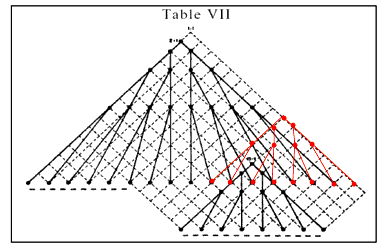
Gunther’s table VII shows, in black, trees with different origins and proto-structural overlapping. The added red tree is overlapping with another tree, in black, additionally at common proto-structural places. The black tree is producing a differentiation of 3 decisions to meet the red tree which has at the common places realized a differentiation of only 2 decisions.


As a first step to escape the hierarchy of thinking and will, a chiasm between both has to be established. That is, a distribution and mediation of the thought/will relationship has to be installed. This, as a second step, is possible only on the base of non-propositional, non-semiotic deep-structures which are offering a grid to place the thought/will relationship over different loci. The tree-structure of diaeresis corresponds to the rational thinking, the placement of the tree in the proto-structure is not itself a cognition but a volitional decision.

Interactions of trees onto the proto-structure
In this constellation, Table VII, there are, for the red tree, 7 overlapping situations and 8 non-overlappings of the total of 15 possibilities of the red tree. The black tree, with its different origin has a longer "history". With its 31 situations, only 7 are overlapping together with the red tree. Thus, the harmony of coincidence is not balanced. The red tree has only 8 "free" positions, while the black tree has 24, thus, having a more complex "history".

Interestingly, the overlapping of the red tree with the black tree at the 7 situations is based on a "history" of nil common situations. What is common to both is their being distributed over the proto-structural grid and their meeting at 7 common situations. This is the global analysis.

A focus on the local constellations/situations has to consider the equality of the common positions in their locality. That is, both arrived at those locations and from a local point of view it doesn’t matter how they arrived and from where. Not enough, there is even another binary tree in the game. Its origin is located at another position. Both, the red and the black tree, are involved in proto-structural overlappings with this second (black) tree.

Double Blind Spot
With only a one-step move of the root of the red tree, a fully harmonic overlapping results, with a base, again, of nil common positions. This kind of overlapping is locally suggesting full harmony; globally, it is maximal under-balanced producing the possibility of highest mismatch. Because there is no common "history" realized by the different trees, what seems to be harmonic coincidence can turn out to be a mismatch. They are also blind for the fact of being positioned in a proto-structural grid. This kind of overlapping should be called a Double Blind Spot. Probably the conditio humane of actual inter-cultural communications.


4. Is Chinese centralism the same as the Western?
"Modern society is a polycentric, polycontextural system. (…) Consequently there must be transjunctional operations, which make it possible to go from one contexturality into another, still marking which differentiation is accepted or rejected for specific operations."
(Luhmann 1996).
http://www.qvortrup.info/lq/pdf-misc/Hypercomplex.pdf

The multitude of Chinese spoken languages can be seen as a distribution over the uniqueness of the Chinese writing system. This is not only a multitude of different interpretations of a character in the sense of a polysemy of meanings, but the different interpretations are offered by the hieroglyphs the space to be distributed. Thus, different languages incorporating different points of view are mediated by the uniqueness of the hieroglyphic writing system.
Such a system is poly-centric and polycontextural, not only in a linguistic sense but also politically, economically and culturally. With each spoken language, or with each contexture established, the speaker will follow, ideally, the logical structure of diaeresis and its principle of tertium non datur (TND).
Therefore, it is reasonable to think of a distribution of different diaeretic systems mediated by their common written background or hieroglyphic deep-structure of the writing system.

"Polycentrism characterizes a society that cannot observe itself or its environment from a single observational position–or, rather, from within a single observational perspective or “optics”–but has to employ a large number of positions of observation, each using its own individual observational code to manage its own social complexity. This implies that no universal point of observation can be found. Furthermore, this means that a large portion of these observations are observations of observations:[...]." ibd.
It is obvious, that a similar mediation of different spoken languages, like in the Chinese case, is not accessible for Europeans. If a Norwegian and a Catalan person or administration want to communicate, they don’t have, despite their common general European culture, a common system of linguistic or semiotic reference.
Today, this problem of communication is basic for the development of a Semantic Web (Web 3.0). The hope for a solution is found in a common general ontology/taxonomy which is denying all the historic and cultural differences between the different European languages. Such Semantic Web activities are in favor for machine-readability. It further turns out that the concept of European polycentrism is a myth proposed in a notional format, lacking any operativity; supporting in practice by necessity strict political and juridical centralism.

It is said, that we have not to be slaves of our historic writing systems. We can think against their restrictional tendencies. Yes, with which tools? And are not the tools determining our results?

Today, all sorts of narratives about complexity, interactivity, mediation, autonomy and self-organization are on the market. But to talk and write about a topic is not to produce an operational calculus able to master it.

Thus, after the introduction of these grammatological exercises, and to escape the common Double Blind Spot, the question naturally arises:

Can Chinese centralism be the same as Western centralism?