Thursday, March 29, 2007

Proto-Structure of Diamond Strategies

„Everything is true: not everything is true; both, everything is true, and
not everything is true; or, neither everything is true nor is everything not true.
This is the teaching of the Buddha.“ Madhyamika Karika

Beyond names and propositions, again
Without getting lost into the deepness of philosophical and grammatological studies we can apply the mechanism of proto-structure, i.e., the activity of tetraktomai,i.e., to use the tetraktys, on a more common arena of emotive-cognitive organization in communicational situations. The Diamond Strategies are obviously operating beyond notions and statements, thus, if applied in therapeutic situations, they are not primarily a "talking cure" (Freud).

Our orientation in the world is mainly guided by sentence/notion based thematizations. To diamondize, like to tetraktomize, is to abstract and to subverse this semantic level of thematization in favor of its dynamic patterns, i.e., the morphograms of interaction/reflection of communication.
The process of morphic abstraction is pushed by questioning the existence (ek-sistenz, Heidegger) of the communicand (client).
The existence is what can be abstracted from the historic and local stories of the person involved. But such an existence is not identical with an identical kernel of a self or ego of a person(a) (mask).

In Ancient time of Pythagoras and the Chinese and Indian thinker, this procedure was not an abstraction but the genuine and direct way of approaching reality.

In a form, reduced to logocentric purposes, the diamond is well known in the West since Aristotle as the Square of Oppositions, and it had many modern applications in logic (Belnap, Fitting), psychology (Piaget), semiotics (Pierce), linguistics (Greimas), etc. Today general studies of the "Square of Oppositions" are promoted by the Universal Logic group which is running its 2nd World Congress at Xi'an, China.
Obviously, the Diamond Strategies are not excluding such logical studies of the Square but are not to gather under their umbrella.

There are many existential and emotional strategies today to defend ones established attitudes against a new way of thinking and thematizing the world.
One is well documented in the Gödel-Günther-Correspondence.
To overcome such barriers, the Diamond Strategies always had been of great help.

Proto-Structure of the Diamond Strategies

Also deconstruction is not simply a method, Derrida gives us some general strategies of deconstruction.

Reversion of hierarchy
"In a traditional philosophical opposition we have not a peaceful coexistence of facing terms but a violent hierarchy. One of the terms dominates the other (axiologically, logically, etc.), occupies the commanding position. To deconstruct the opposition is above all, at a particular moment, to reverse the hierarchy." (Derrida, Positions, 56-57).
The double gesture displacements
"Deconstruction must through a double gesture, a double science, a double writing, put into practice a reversal of the classical opposition and a general displacement of the system. It is that condition alone that deconstruction will provide the means of intervening in the field of oppositions it criticize and which is also a field of non-discursive forces." (Derrida, Marges, 392)
Interestingly, the Diamond Strategies are incorporating both Ancient attitudes:
1. The tetralemmatic and tetractic way of conceiving truth (Buddha, Pythagoras), and
2. the pragmatic or praxeological apraoch of Chinese thinkers to the relevancy of statements as opening futures instead of claiming eternal truth.

Let us play the game of the Diamond Strategies

From the frozen attitudes of our hierarchical thinking and feelings to the endless flow of inventing and co-creating our futures in the open chiasm of systems of multiple opposites.

Step one: Position (Problem, Conflict)
Describe your state or situation of the moment with a good, short but precise statement. It´s your statement of position, affirmation, it´s your starting point of the game.

Question1: What is the situation/constellation you want to explore/re-solve?

Go with your personal starting statement as deep as possible into your emotional and/or cognitive state. Ask yourself about your state formulated in your first starting statement. Elaborate the semantical and emotional context of this statement. Take your last/best sentence of your exploration of your feelings and thinking of your situation and write it down.

Step two: Opposition (Subversion, Solution)
Create the opposite of your state, of your belief statement, of the sentence which describes your situation most concrete.

Question2: What is the opposite of your starting position?

Our language gives us a lot of possibilities to build opposites: logic, grammar, semantics, word games, phonetics, writing, gestures etc. It´s not only negation, you also have inversion of all sorts of order in a sentence or between sentences, dualities, reflections, mirroring and many other methods of translating a statement into it´s opposites.

Example
Position: Nobody loves me.
first opposite: Everybody loves me.
second opposite: Everybody hates me.
third opposite: Everybody loves you.

I would like this one as a nice opposite of "Nobody loves me." :: "I love anybody."

What are the connections between the position and the opposites? You are discovering a Semantic Field of statements between position and its oppositions.

Third step: (neither-nor-): sovereignity
Change between your two states (position vs. opposition). Take position and all feelings for the one, and then take all feelings and surely also all thoughts for the other one.

Question3: What's your neither-nor of position/opposition?

Change and feel what happens when you are changing from position to the opposite. Play this transition game as often until you feel and think that both are equivalent (like light/shadow). Then you will feel immediately that you are free from both: you are not the one and not the other.

You as a subject, as a person you are neither this nor that. This insight and this feeling, that you are not identified with one of the sides of the opposite is your third position. Here you are free, you have the most possible distance to all of the world. Then, how do you see the two other positions, how do you feel them? Go back to the first and to the second. Which do you like most? Play the game until you feel all three positions as equally relevant. All three belongs to you.

Fourth step: all of that at once - pure richness
But this is not all we can do. We can also have the opposite of this distance and sovereignty of the 'neither-nor'. It is the fourth position of 'both-at-once'.
Now you have often changed your positions and you had have very strong feelings and insights in this three positions and transitions. You will discover that all this belongs to you. And not only one after the other but all at once. You are all that at once. You are both position and opposition.

Question4: What is your both-at-once of position/opposition"?

Re-Solution
Then you make the complete trip: you go around the 4 positions in at least 6 primary steps, you have 24 permutations of your primary steps- that's your universe of experience(s) at this very first step within the Diamond Strategies.

Exploration
Each station of the Diamond elaborated serves as a new starting point (Position) for further diamondized explorations of your complex emotional/cognitive space.
With the game of the Diamond Strategies you have deliberated yourself from your fixation on one point of view in describing, reflecting, feeling, deciding, organizing etc. your life, your future of your organization or company.

Opening existential futures: Enabling vs. disabling

All of the four positions of the first Diamond Strategies can be asked about the future possibilities, about their perspectives, about their horizon of new behaviours, etc.
You can ask: What enables me this, which are the new possibilities for me, what new chances are opened up by this state, position etc. for me.

First Step: Enabling vs. disabling
Take one of the 4 positions of the Diamond, then ask one of the questions about enabling/disabling.
1. What is the position enabling/disabling,
2. What is the opposition enabling/disabling,
3. The neither–nor– of enabling and disabling,
„What neither enables nor disables me A?“
4. The both–and– of enabling and disabling,
„What both at once enables and disables me A?“

Second Step: Iterations
You can also freely repeat and alternate your questions about enabling and disabling, thus producing a grid of enabling/disabling positions.


Diamond Strategies of Thematizations

After the more existential application of the Diamond Strategies we are applying them onto the linguistic and grammatological situation of notion/proposition.

Designing the Diamond
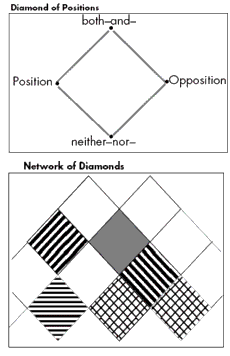
A possible Diamond of notion/sentence can be established as:
Notion: name-based conceptualization,
Proposition: proposition-based thinking,
Morphogram: neither name nor proposition,
Inter-textuality: both at once, name and proposition.


Iteration of the Diamond
notion–––>proposition–––>notion

Accretion of the Diamond
proposition as position, new opposition could be text.
morphogram as position, new opposition could be image.
inter-textuality as position, new opposition could be medium.


The diagram shows a possible accretion of the first diamond. There is no strict necessity to develop the diamond this way, other decisions for an interpretation of the knots can enter the game, producing other interpretations of diamonds.

Diamondize vs. Syllogisms
Trees are graphic representations of the notional entailment relation which is at the base of logical thinking, deduction, not restricted to Aristotelian syllogism only.

It is of importance to understand that such an accretion is not building a subordinating order, like a diaeresis, thus, it is not a pattern founding deduction, syllogism and linear or tree-like conceptualization. The knots of this diamond, understood as a proto-structure, can be themselves starting points, origins, for binary trees.

Because of its commutative structure, the graph of the proto-structure is a grid and has neither an origin nor an end. Thus, it might be slightly misleading to write the proto-structure with a beginning (1:1) as it is presented in Gunther’s papers. This happens for notational purpose only.

Neolithic Incisions

Excursion: Some early orientational systems
At a time of human development, long before the advent of names, notions, sentences and numerals, and images too, there had been incisions, structuring the orientation in the world and co-creatively enabling the advent of human beings.

It is the work of the archeologist Marie König to have discovered those early incisional systems.

Interestingly, most of the basic patterns are at place.
Diamonds, grids, circles, points, and systems of different patterns.
Not necessarily binary trees?


It seems obvious to understand these patterns
as cosmic orientation systems. And obviously not being connected to cognitive and linguistic units, like propositions, names, numbers and images, despite their importance, probably, as the very first orientational writing systems.
"Erst die griechischen Naturphilosophen verurteilten die Auswüchse des mythischen Denkens. Sie begannen, ein neues Bild vom Kosmos zu entwerfen und leiteten damit eine neue geistige Entwicklungsstufe ein. Diese Zeit wird gern als der Anfang des europäischen Denkens angesehen, im Gegensatz zum mythischen Denken, das unwissenschaftlich, ungeistig und unrealistisch zu sein schien. Weiter als bis zur Mythologie reichte weder das Gedächtnis der Menschheit noch das Zeugnis der Schriftquellen zurück, und man suchte den Anfang der Kultur dort, wo die Schrift begann, also in den orientalischen Hochkulturen, die in Wirklichkeit einer hochentwickelten geistigen Entwicklungsstufe zuzurechnen sind. Damit verlor unsere Kultur eine Dimension der Tiefe. Wir hatten unseren geschichtlichen Ursprung verloren." (presented by Esther Keller-Stocker) http://www.theologie-vision.eu/bewusst/marie_koenig/koenigII.htm
Marie E.P. König: Am Anfang der Kultur, Die Zeichensprache des frühen Menschen, Gebrüder Mann Verlag Berlin 1973.


["Not until the Greek ancient philosophers condemned the excrescences of mythical thinking. They began to sketch a new picture of the cosmos and introduced with it a new spiritual stage of development. In contrast to the mythical thinking, which seemed to be unscientific, unspiritual and unrealistic, this epoch is regarded gladly as the beginning of European thinking. As up to the mythology neither the memory of mankind nor the testimonial of the sources of writing continued to go back, and one looked for the beginning of culture, where the writing began, thus in Eastern advanced cultures, which in fact are part of a highly developed spiritual stage of development. Thus our culture lost a dimension of profoundness. We had lost our historical origin."]

Chinese Centralism?

Beyond propositions, names, numbers and advice

"But what has still not been seriously investigated in modern linguistic analysis during the course of secularization of myth, religion, and metaphysics is the increase of secularization on human language. In its insect like persistence, in which it naively supposes that Man and not the universe as a whole is the proper subject of speech and thought, it has completely forgotten God and myth, which both await their metamorphosis." G. Gunther

Summary
The question arises: Is there any rational structure beyond name- and sentence-oriented thinking?
Or: Is there a rational operativity beyond alphabetic sign systems?

In an idealized form, both, name- and sentence-based thinking, are depending structurally on trees. Well known as binary trees of diaeresis or Porphyrian trees. Today as XML trees. The same holds for generalized sign systems, i.e., semiotics. But today, the tree model of organizing knowledge is producing more problems than it solves in complex computing.

Post-modernism has hallucinated the metaphor of net or rhizomatic writing, but didn’t provide any operativity to be useful for real world problems, like programming. Media theorists are fantasizing about the structure of the Web as decentralized, open, complex, heterarchic and not hierarchic at all. They are lost in the chaos of surface-structures, not being able to recognize the strong and strict mathematical centralism and hierarchic organizational order of the Web’s deep-structure.

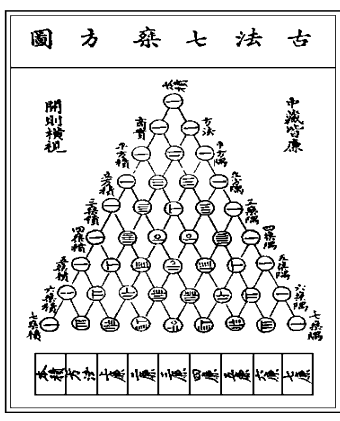
The acceptance is slowly growing that pre-modern thinking of Pythagoras in the West and Ancient Chinese is neither name nor sentence guided, hence not to be organized by any tree structure. How could such a structure look like? The simplest structuration of Ancient thinking can be supposed as a pre-semiotic proto-structure, realized in history by a triangle model, i.e., a commutative graph, by the Ancient (Pythagoras, Yang Hui, later Blaise Pascal). Each knot of a triangle model is over-determined and therefore logically contradictory.

This structure was re-discovered by the Western thinker Gotthard Gunther for the purpose of mediating number and notion as well as thought and will and exposed in his theory of polycontexturality and kenogrammatics. The proto-structure is offering a devise to distribute and mediate a multitude of binary trees and studying their interactivity and reflectionality in an operative and computable way. A similarity between such a distribution of binary trees over the proto-structure and on the other side, the multitude of spoken Chinese languages and their common scriptural system is proposed.

It is my experience that there are strong existential and emotional defence strategies and barriers which are preventing people from learning about such ways of pre-semiotic thinking. Thus I introduce a format to deal with such anxieties: The Diamond Strategies.
Surprisingly, the Diamond Strategies are in a good correspondence and harmony with Ancient Indian and Chinese formats of thinking and acting as well with Gunther’s concept of proto-structure.

Of the many practical applications possible, only one question is proposed, re-opening a new round of thinking the Chinese Challenge aiming to surpass the common Double Blind Spot:

Can the Chinese Centralism be the same as the Western?


1. Name-oriented languages

Modern linguistics as the study of sign and languages systems in general, has to be separated from the philosophical decisions to focus on certain language interpretations, like the noun-, proposition-, action-oriented understanding of language. The aim of this study is to make some steps toward a reasoning beyond such decisions for propositions and their hierarchy (diaeresis) in favor of a new way of orientation and computation guided understanding of thematization and symbolization by the decision for polycontexturality and kenogrammatics.

Chad Hanson writes about the linguistic analysis of Chinese language by Chinese thinkers.
"Chinese linguistic thought focused on names not sentences."
"This explains the anomaly of treating all terms as 'names,' but fails to explain the similar treatment of adjectives and verbs. Lack of function marking is again part of a possible explanation. Adjectives used in nominal position did not undergo abstract inflection so theorists treated 'red' and 'gold' as analogous. They could associate descriptive adjectives, like mass nouns, with a range or "extension" and view adjectival "names" as distinguishing one range from others. The ranges distinguished by different "names" can overlap. In those cases, they would use compound "names." Distinguishing between the ways adjectives and nouns worked in compounds produced puzzles for pre-Han theorists."

"Zilu said, ‘The ruler of Wei awaits your taking on administration.
What would be master's priority?’ The master replied,
‘Certainly--rectifying names!’ . . . .
If names are not rectified then language will not flow.
If language does not flow, then affairs cannot be completed.
If affairs are not completed, ritual and music will not flourish.
If ritual and music do not flourish, punishments and penalties will miss their mark.
When punishments and penalties miss their mark, people lack the wherewithal to control hand and foot.
Hence a gentleman's words must be acceptable to vocalize and his language must be acceptable as action.
A gentleman's language lacks anything that misses--period.(13:3)"
http://www.hku.hk/philodep/ch/lang.htm

A chain of terms is build: rectification/names –> language –> ritual/music –>
punishment/penalties –> control
==> acceptance of vocalization/action.

This chain of terms, from rectifying names to the acceptance of vocalization and action, suggests a linear and hierarchic order of entailments. There are no chiastic elements or relations involved. But there is also no system mentioned in which the hierarchic development takes place. Thus, it is open to interpretations.

Cyclic and chiastic order
If, on the other side, it is said, that "war becomes peace and peace becomes war" (Confucius, Heraklit) a cyclic and chiastic (dialectic) order is established. What is basic in this approach are not the names and notions involved but the rules of the interplay between them. This chiastic model, even still archaic, is neither sentence- nor notion-based. The change, the differences of the play are primary to the notions involved. Because of its chiastic form, the whole statement is in itself also not strictly a sentence or proposition in the definitional sense. Because a sentence is based on the hierarchy of subject and predicate.

Chiastic forms are circular, violating the hierarchy of propositions. Thus, the operator "and" is not simply a logical or linguitic conjunction but a term for mediation between the two order relations between war and peace. There is no reason to thematize chiastic formations as name-based. This change as such is neither name- nor proposition-based, but a chiastic interplay between the terms.
In the terminology of polycontextural logic, this situation is modeled by the proemial relationship.

2. Thought, will and numbers

Name/proposition/contexture or sign vs. kenogram
Before the digitalists have overtaken Western ideology, the philosophical trend of the "linguistic turn" was dominating the theory of science as "analytic" philosophy. Sentence, statement, proposition, etc. based thinking was confronted to noun/name/notion-based thinking. Their conclusion was, the one who is not opting for propositions is poised to be stuck in the archaic name-oriented approach.
Gödel and Gunther didn’t decide for the linguistic turn. Nor had they been lost in the past of name-oriented disorientation.

Now, it is said, that Ancient Chinese thinking is not sentence-based, thus it has to be noun-based; TND. "Chinese linguistic thought focused on names not sentences." Contextures and even more, kenograms, are not involved into this logocentric game of names and sentences. Not even in texts and contexts, and their inter-textuality as it was introduced and studied mainly by the French structuralists and deconstructivists.
Kenograms and morphograms are understood as patterns of actions. In Günther’s words, they are the general "Codex für Handlungsvollzüge".

Ancient pragmatic advise: Tetraktys as a device
Like Chinese thinking, Pythagorean thinking was action-oriented and not concerned with the eternal truth (of axiomatic systems). Action-orientation is not simply the pragmatic dimension of logocentric sign systems.

The Pythagorean tetraktys was not primarily a concept but a device: to do the tetraktys, i.e., to tetraktomai. To tetraktomai is to produce the grid of the proto-structure. The tetraktys doesn’t stop with the number 4, it starts with it. But in ancient time, there was no theory of action but material advices for a better life, only. Learnable in secret schools from teachers or from Guru’s.
Today, advices have to become programs to compute new chances in a changing world.
Yang Hui (楊輝, c. 1238 - c. 1298)
http://www.roma.unisa.edu.au/07305/pascal.htm
Pascal Triangle:
http://www.csam.montclair.edu/~kazimir/construction.html

Gotthard Gunther's Proto-structure
http://www.vordenker.de/ggphilosophy/gg_life_as_polycontexturality.pdf
http://www.vordenker.de/ggphilosophy/gg_identity-neg-language_biling.pdf

Hierarchy and heterarchy of thinking and action
Occidental philosophy is mainly thought-orientated. Thoughts are represented in statements and statements are represented in written sentences. Then, on the base of sentences, action can happen. Thus, scripturality is secondary. In other words, thoughts in established Western philosophy are first, will comes second. But Western technology is on the way to turn this hierarchic order into an action-based paradigm. Until now, this inversion happens proposition-based, i.e., the logic of action and programming is still the logic of propositions. This happens in different forms, sometimes hiding its logocentric origin, like with the lambda calculus.
There is no reason to belief that a simple inversion of the hierarchic order is of any real help. Both systems are more or less isomorphic and are building a symmetric dualism. There is not much research to observe which would intend to change this situation of semiotic based hierarchy.

Chinese thought, it was said, is action-based. But as we have shown often enough, this paradigm of action is not based on the same world-model as the Western sentence-based. The crucial asymmetry between the Chinese writing system and its linguistics are building the deep-structure of its action based paradigm. Hence it would be a serious mismatch to identify both concepts, the Chinese and the Western concept of action.
But Chinese thinking has not yet considered to formalize the heterarchic operative structure of its writing system. We can say, the West achieved to formalize its phonologic writing system to the highest perfection. The results are now propagated globally as the ultimate ratio and universal truth.

3. Diaeresis on Proto-Structures

Logic systems distributed over the proto-structure.
Linguistic and logical structure of diaeresis: genus proximum/differentia specifica.
Up and down; the same. (Diels)

But the conceptual use of the triangle is in strict conflict to the binary structure of diaeresis.
The way up and the way down have not to coincide.
Diaeresis is applicable to both approaches, the sentence- and the notion-based.

Different numeric interpretations of the proto-structure
The abstractness of the grid enables not only different notional or symbolic interpretations but is also serving for different numeric calculations. The closest numeric interpretation of the proto-structure is given by the fact of the number of the knots of the grid. This corresponds exactly to the Pythagorean numeric interpretation of the proto-structure. In contrast to the number of knots in the dyadic tree of the Platonic diaeresis, which corresponds the series of 1, 3, 6, 10, ... , the Pythagorean series of knots corresponds to 1, 3, 7, ... Thus differing at position 3 with 6≠7.

Plato’s Diaeresis onto Gunther’s Proto-Structure
Strictly separated diaeresis systems, i.e., binary trees, localized at their common proto-structure, are offering communication as semiotic morphisms (Joseph Goguen) between them. Overlapping diaeresis systems are producing conflicts in communication because the may hide the lack of a common history. At the point where communication seems to be realized, mismatches are produced and their reasons are hidden as blind spots. That is, the semiotic isomorphisms between the different diaeretic systems can not be established because they are violating the condition of separation.
Both diaeretic or semiotic systems have to be disjunct in respect of their elements to enable conversation between autonomous partners. Only if the overlapping can be reduced to an overlapping of the full trees, the conflict is resolved in coincidence. An overlapping of knots (terms) does not mean that the terms have the same meaning. Simply because they are defined by different notional backgrounds (histories).

Diaeresis, binary trees and proto-structure
From Plato’s hierarchic pyramids, Porphyries notion-trees to the tree structure of XML. Trees, everywhere. Diaeresis is not an esoteric structure or an ancient and obsolete method of organizing knowledge. In its form as binary trees it has become a nearly universal method of thinking, computing and organizing knowledge and actions.
But with trees we are getting into trouble. It is also not enough to have forests of trees instead of a general tree. Even the trees in a forest may play some kind of multitude, there are no mechanisms at all to realize interaction and reflection between trees. What’s between trees is not itself a tree.

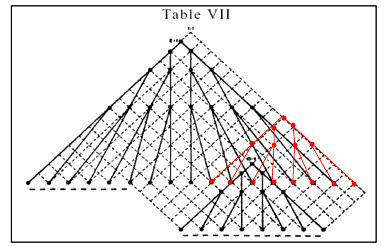
Different trees can be mapped onto the proto-structural grid. Gunther has given some examples of binary trees on proto-structures with different origins and common overlapping at proto-structural places. This can be freely extended to overlapping of binary trees, not only on common proto-structural places but at overlapping places of the trees themselves.
Gunther’s table VII shows, in black, trees with different origins and proto-structural overlapping. The added red tree is overlapping with another tree, in black, additionally at common proto-structural places. The black tree is producing a differentiation of 3 decisions to meet the red tree which has at the common places realized a differentiation of only 2 decisions.


As a first step to escape the hierarchy of thinking and will, a chiasm between both has to be established. That is, a distribution and mediation of the thought/will relationship has to be installed. This, as a second step, is possible only on the base of non-propositional, non-semiotic deep-structures which are offering a grid to place the thought/will relationship over different loci. The tree-structure of diaeresis corresponds to the rational thinking, the placement of the tree in the proto-structure is not itself a cognition but a volitional decision.

Interactions of trees onto the proto-structure
In this constellation, Table VII, there are, for the red tree, 7 overlapping situations and 8 non-overlappings of the total of 15 possibilities of the red tree. The black tree, with its different origin has a longer "history". With its 31 situations, only 7 are overlapping together with the red tree. Thus, the harmony of coincidence is not balanced. The red tree has only 8 "free" positions, while the black tree has 24, thus, having a more complex "history".

Interestingly, the overlapping of the red tree with the black tree at the 7 situations is based on a "history" of nil common situations. What is common to both is their being distributed over the proto-structural grid and their meeting at 7 common situations. This is the global analysis.

A focus on the local constellations/situations has to consider the equality of the common positions in their locality. That is, both arrived at those locations and from a local point of view it doesn’t matter how they arrived and from where. Not enough, there is even another binary tree in the game. Its origin is located at another position. Both, the red and the black tree, are involved in proto-structural overlappings with this second (black) tree.

Double Blind Spot
With only a one-step move of the root of the red tree, a fully harmonic overlapping results, with a base, again, of nil common positions. This kind of overlapping is locally suggesting full harmony; globally, it is maximal under-balanced producing the possibility of highest mismatch. Because there is no common "history" realized by the different trees, what seems to be harmonic coincidence can turn out to be a mismatch. They are also blind for the fact of being positioned in a proto-structural grid. This kind of overlapping should be called a Double Blind Spot. Probably the conditio humane of actual inter-cultural communications.


4. Is Chinese centralism the same as the Western?
"Modern society is a polycentric, polycontextural system. (…) Consequently there must be transjunctional operations, which make it possible to go from one contexturality into another, still marking which differentiation is accepted or rejected for specific operations."
(Luhmann 1996).
http://www.qvortrup.info/lq/pdf-misc/Hypercomplex.pdf

The multitude of Chinese spoken languages can be seen as a distribution over the uniqueness of the Chinese writing system. This is not only a multitude of different interpretations of a character in the sense of a polysemy of meanings, but the different interpretations are offered by the hieroglyphs the space to be distributed. Thus, different languages incorporating different points of view are mediated by the uniqueness of the hieroglyphic writing system.
Such a system is poly-centric and polycontextural, not only in a linguistic sense but also politically, economically and culturally. With each spoken language, or with each contexture established, the speaker will follow, ideally, the logical structure of diaeresis and its principle of tertium non datur (TND).
Therefore, it is reasonable to think of a distribution of different diaeretic systems mediated by their common written background or hieroglyphic deep-structure of the writing system.

"Polycentrism characterizes a society that cannot observe itself or its environment from a single observational position–or, rather, from within a single observational perspective or “optics”–but has to employ a large number of positions of observation, each using its own individual observational code to manage its own social complexity. This implies that no universal point of observation can be found. Furthermore, this means that a large portion of these observations are observations of observations:[...]." ibd.
It is obvious, that a similar mediation of different spoken languages, like in the Chinese case, is not accessible for Europeans. If a Norwegian and a Catalan person or administration want to communicate, they don’t have, despite their common general European culture, a common system of linguistic or semiotic reference.
Today, this problem of communication is basic for the development of a Semantic Web (Web 3.0). The hope for a solution is found in a common general ontology/taxonomy which is denying all the historic and cultural differences between the different European languages. Such Semantic Web activities are in favor for machine-readability. It further turns out that the concept of European polycentrism is a myth proposed in a notional format, lacking any operativity; supporting in practice by necessity strict political and juridical centralism.

It is said, that we have not to be slaves of our historic writing systems. We can think against their restrictional tendencies. Yes, with which tools? And are not the tools determining our results?

Today, all sorts of narratives about complexity, interactivity, mediation, autonomy and self-organization are on the market. But to talk and write about a topic is not to produce an operational calculus able to master it.

Thus, after the introduction of these grammatological exercises, and to escape the common Double Blind Spot, the question naturally arises:

Can Chinese centralism be the same as Western centralism?

Thursday, February 15, 2007

A little typology

Writing and world models

The little typology of writing paradigms is confronted with the "Diagrams of the 4 World-Models". The 4 world-models are modeling the 4 possible configurations between rationality and reality or logics and worlds.
A correspondence between the 4 paradigms of writing and the 4 world-models may be established. Each subject is realizing the spirit/mind/speech/writing/reality relation, i.e., its reality/rationality or world/logic relation in a specific world model.
http://www.thinkartlab.com/pkl/media/SKIZZE-0.9.5-Prop-book.pdf

Phonologism of Western Writing
This is the scheme of a logocentric understanding of writing. It corresponds t
o the dominant tradition of Western philosophy and linguistics. But there are no surprises to observe that this scheme holds in a similar way in other cultures, too.

Aristotle, On Interpretation:
“Spoken words are the symbols of mental experience
and written words are the symbols of spoken words”.


Hegel writes in his Encyclopaedia of the Philosophical Sciences, Part III: The Philosophy of Spirit (1830)
"Alphabetic writing is on all accounts the more intelligent: in it the word ą the mode, peculiar to the intellect, of uttering its ideas most worthily ą is brought to consciousness and made an object of reflection." http://www.thinkartlab.com/CCR/2006/08/alphabetism_29.html

World model I: One world one logic

So: transcendental subject, Ultimate Universal Logic, not accessible to empirical subjects.
Oo: transcendental object, Ultimate Eternal Reality, not accessible to empirical subjects.

Si: empirical subjects.

Oi: empirical realities.

One sentence :: one meaning
Perfectly realized by normed alphabetism. Isomorphism between written sentence and its meaning. Sentences are thought as names of objects (entit
ies). This is the position of realism and platonism.

Semantic truth condition
(Tarski):
correspondence between meaning and reality.

Grammatology of Chinese Writing
This scheme corresponds to the Chinese understanding of writing as it is exposed by Liu Hsieh. There are similarities in the pre-Aristotelian tradition of Plato and Pythagoras to find.
http://www.thinkartlab.com/CCR/2006/10/liu-hsiehs-grammatology.html

Gotthard Gunther
"That is, in holding to the ideograms, lies an unconscious insight of a massive asymmetry between spoken and written language.
It is the written language, on which a main culture rests. It possesses an identity strength, which stands out clearly against the identity weakness of the spoken word." http://www.thinkartlab.com/CCR/2006/09/gnthers-asymmetry.html

World model II: Many worlds one logic
Many sentences :: one meaning
Situation of the interpretation of Chinese hieroglyphs by negotiation.
Hieroglyphs are unifying many sentences in one scriptural pattern. The hieroglyphs have a mediating function to the plurality of interpretative sentences. Such sentences are not isolated and unrelated to each other. The model of thinking is not dominated by the concept of sentences or names. But by the written hieroglyphs which have to be interpreted. Thus, this model is relational and focussed on the interplay between writing and speech. But this interplay between scriptural and interpretational activities is not yet itself inscribed (conceptualized and formalized). It is realized in practise of communication in the Lebenswelt.

Actional truth condition
:
True, iff accepted by all negotional partners involved.


Graphematics of Chinese Writing

The graphematical model of writing is emphazing the practical aspect of schematic work in form of the computation by an abacus. This is in strict contrast to the still "logos" related writing of the grammatological model.
Hence, this scheme is considering the influence of technological and cultural practise on the paradigm of writing. The emphasis is on the influence of the usage of the Abacus on reality and on the concept of literal and algebraic writing. It is thought that the development of the concept of zero and the organizational system of positionality is an interpretation of the practice of the usage of the Abacus in calculations. Hence, techniques of computations have influenced the general structure of writing. Especially the invention of the concept and notation of zero.
http://www.thinkartlab.com/pkl/lola/Abacus.pdf

World model III: One world many logics
One sentence :: many meanings
Polysemy of sentences solved by modal logic of alphabetism. Sentences are deliberated from their fixation to names. They have different meanings depending on different contexts which are themselves defined by sentences. Thus a kind of circularity is involved. This is the position of constructivism and relativism.

Model theoretic truth condition
(Kripke):
True, iff true in all contexts.


Morphogrammatics and Polycontexturality

Proemiality of scriptural and hermeneutic procedures
.
The mind is strongly embedded into reality. Reality is reflected by the minds activity of writing, speech and interaction. The mind is part of the technology of human activity. Human activity is embedded into reality.
http://www.thinkartlab.com/CCR/2006/10/blog-post_07.html

World model IV: Dissemination
The hegemony of one world and one logic is destroyed and disseminated over a multitude of loci constituting a new world containing both, the rationality and the reality in it. The focus is on the distribution and mediation of the disseminated origins.

The hegemony of the origins is rejected and destroyed. But the focus is on its rejection and destruction, i.e, on the autonomy of the different rationality/reality relations and not on their mediation and localization inside a new world model like in the constellation of rejection.

The structural properties of the fourth world model is principally different from the 3 other world models. In contrast to them, it can not be modeled by one and only one model. Its model is paradoxical, over-determined, ambiguous and dynamic.
World model IV has space to place the 3 other models of writing/meaning in itself.
http://www.thinkartlab.com/CCR/2006/10/semiotics-to-morphogrammatics.html

Many sentences :: many meanings
The plurality of sentences and meanings is not dispersed in isolate
d units but mediated to a compound structure of writing and interpretation. The interplay and chiasm between writing and meaning is primary. It is realized as interactional and reflectional activities between script and meaning on the base of a tabular conception of notational systems. This actional understanding of writing and meaning is dynamic, complex, open for its history and future.
http://www.thinkartlab.com/pkl/lola/Godel_Games-short.pdf

Table of models


[click on the picture to enlarge ]

Monday, February 12, 2007

SLOGANS for the Chinese Challenge-Video

Since my last entry I learned that this Blog is best understood by the new generation of Chinese people for which the big economic, political and military "re-awakening" of China has become already normality.

They are the children of this enormous effort. They are traveling and studying all over the world – and experiencing the differences and foreignness even to their own people abroad.

They love their country, are proud of it and don't want that its specific Chinese culture get lost.

While adapting to the Western culture, they didn't had a chance to be specially educated into the specific characteristics of Chinese culture.
Neither into the Ancient nor into Mao's Cultural Revolution.


To be more comprehensible to this new generation I will start to publish a series of Video Clips to the topics of this Blog.

With the help of this Video Clips it will be easier to understand the more elaborated texts of this Blog and my Website.


SLOGANS

The Chinese Challenge:: 中国挑战

Hallucinations for Other Futures


What can we learn from China that China is not teaching us?


Where are we now?

Europe
Europe is lost in its search of the dying and buried roots in Greek heritage.

US-America
The success of America is based on the rejection of European roots.
Today, the US-American dream is exhausted and has come to a closure.
The decline of America is rooted in its lack of own roots.

China
China has found its roots again to build a future.

What makes the difference?

Main cultures are always depending on their way people are writing.

Writing in general is the most abstract mechanism and technology of cultural live.
Western culture depends on alphabetic writing.
Its calculation and computing is based on the Indian concept of Zero.

The thinker Leibniz had a first European hallucination about Chinese writing.
He conceived in his hallucination the idea of a General Language (Lingua Universalis) as a base for negotiable and calculable communication between peoples and nations.

This kind of alphabetic and numeric writing is exhausted and has become a source of destruction and self-destruction of the world and human beings.
Western way of writing is not prepared to encounter the challenges of the future of the world.

China, for the next epoch of humanity, has an advantage to the West: it has its scriptural resources not yet exploited.

The Chinese way of writing is tabular, multi-dimensional, embodied, open, complex and based on the experiences of the oldest cultural tradition of humanity.

The Chinese Challenge today is not its new re-awakening economic, political and military power as the West is fearing and economically exploiting,

The Chinese Challenge is the re-discovery of the rationality of her writing system to come as the roots and resources of a revolutionary new technology for the future.

The Chinese Challenge to China is to preserve its own culture in the process of the transition to a new epoch of humanity.

New Hallucinations?
What we need today is a notational system which would bring together the old wisdom of Chinese writing culture and the success of modern Western technology. How could it be designed?
How could it be hallucinated?


The Chinese Challenge :: 中国挑战-Video


PDFs: The Chinese Challenge-2006
August
September
October

Sunday, October 22, 2006

Liu Hsieh's Grammatology

Again, hallucinating phono-logocentrism in Chinese and Western traditions

First, Han-Liang Chan’s reading of Liu Hsieh
Second, my comments on Liu Hsieh
Third, Florian Coulmas’ Writing Systems
(For technical reasons, again)


Liu Hsieh (465 – 522)

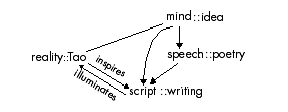
When the mind is at work,
speech is uttered.


When speech is uttered,
writing is produced.


The Tao inspires writing

and
Writing illuminates the Tao.

What in mind is idea

when expressed in speech is poetry.


Isn't this what we are doing

when dashing off writing to record reality?


Writing originated

when drawing of bird trace

replaced string knitting.


P'ien Wen
"The revolt against imitative writing was also expressed in a 5th-century style called "pure conversation", an intellectual discussion on lofty matters. Some of these were recorded in a collection of anecdotes entitled `Sayings of the World'. In the 6th century the first book of literary criticism, `Carving of the Literary Dragon', was published by Liu Hsieh (465-522). It was written in the p'ien wen, or parallel prose, style."

Liu Hsieh's stile and strategy of writing, the P'ien-wen, has an antithetic, parallel and chiastic structure which easily can be seen in the "poetic" presentation of the text.


Han-Liang Chan’s Hallucinations about Liu Hsieh

"However, this kind of mimesis is not different from what traditional Chinese scholars believe. The Chinese version of logocentrism can be glimpsed from the following statements of the sixth-century Liu Hsieh, the first and probably the only systematic literary critic in classical and medieval China.
When the mind is at work, speech is uttered. When speech is uttered, writing is produced. The Tao inspires writing and writing illuminates the Tao. What in mind is idea when expressed in speech is poetry. Isn’t this what we are doing when dashing off writing to record reality? Writing originated when drawing of bird trace replaced string knitting. (13-17)
These statements from Liu Hsieh, which have been so influential, represent different, and sometimes conflicting, theories regarding the origin of writing and its relation to speech. But they share the same belief in an ultimate, transcendental, undifferentiated, and unmediated reality, be it Tao or nature. In some sense, the metaphysics behind such statements is indeed naive and can be deconstructed by a rereading of the Chinese written character. But there is no fundamental difference between it and the Western logocentric metaphysics, which Derrida sets out to dismantle. There is no reason why Derrida’s deconstruction of Western mimesis cannot be done to its Chinese counterpart. Thus I am tempted to ask:
isn’t Derrida, like Leibniz before him, suffering from the same “European hallucination”
that China is of necessity exempt from logocentrism? [...] Under the tyranny of logocentrism, writing is rendered as secondary and subordinate. In Aristotle’s celebrated phrasing which opens

On Interpretation:
“Spoken words are the symbols of mental experience and written words are the symbols of spoken words” (qtd. in Gelb, 13).
This formulation, which Derrida criticizes in The Margins of Philosophy as psychologism, is almost a verbatim paraphrase of Liu Hsieh:
“When the mind is at work, speech is uttered. When speech is uttered, writing is produced.”
Thus in both China and the West, at least in the Aristotelian and Confucian traditions, the category of writing is inscribed only in relation to speech and to the subject of writing.
It is, as Derrida puts it in “The End of the Book and the Beginning of Writing,” “pneumatological” rather than “grammatological” writing (1976, 17). This primacy granted to speech is open to deconstruction. Therefore, Derrida proposes that writing be shifted to the space of arche-writing (trace, différance)."


Complexity and Chiasm of Speech/Script/World

“When the mind is at work, speech is uttered. When speech is uttered, writing is produced.”
This, obviously sounds quite familiar, i.e. Aristotelian.

But the holistic principle of Chinese thinking demands to read the text or paragraph as a whole. I have not to be a sinologist to perceive a fundamental difference between Platonian/Aristotelian phono-logocentrism and Liu Hsieh’s conception.
The Aristotelian concept is hierarchic:
things –> soul –> spoken word –> written word.
"Words spoken are symbols of affections or impressions of the soul; written words are symbols of words spoken. And just as letters are not the same for all men, sounds are not the same either, although the affections directly expressed by these indications are the same for everyone, as are the things of which these impressions are images." Aristotle
Micro-structure of the asymmetry
A more detailed reading of Liu Hsieh shows that the conception he describes is different in, at least, four ways:
1. it is circular : "The Tao inspires writing and writing illuminates the Tao.",
2. it is co-creative: "writing illuminates the Tao" and
3. it is parallel: "What in mind is idea when expressed in speech is poetry./writing to record reality"
4. it is evocative: "Isn’t this what we are doing when dashing off writing to record reality?"

These four properties are corresponding to the general ontology or world-view of Chinese thinking:
1. dynamism: things in the world are changing (circular, chiastic, co-creative)
2. grid and networking: things are complex and interrelated (parallelism, concurrency).
3. holism: situational, all parts have to be considered which are constituting a pattern.
4. interactional/reflectional: the text involves a reader who is addressed in a persuasive, evocative mode.
But it is also self-referential: "what we are doing?"
The circularity is chiastic, not simply repetitive.

Between "writing illuminates" and "Tao inspires writing" exists a qualitative difference depending on the two involved positions: Tao, writer. And "idea in mind" vs. "poetry in speech" vs. "dashing off writing/recording reality".
There is also a historical comment involved.

As a result we can resume that the Chinese model of language is containing the classic Western model as a part of its complexity, and it seems that the Chinese model is more close to (post)modern scientific models of language than to Western philosophical models of language.

Chiasm of writing
Writing as illuminating (acting),
Writing as being inspired (conceiving),
Reality as inspiring,
Reality as being illuminated.
Reality as reality
Writing as writing
Writing as counter-part to reality
Reality as counter-part to writing.

Patterns of distribution
It doesn’t seem a too wild speculation to mention that the Chinese characters are placed in a way that they configure as a pattern. In such a configuration the intertextuality of the characters is of importance. For the eye, interconnections between the characters are perceivable. It is not depending on the listening of the linear ordered words and sentences but on the visual collection of the placed glyphs. Such situations are well known, also in the West, in modern poetry. A further analysis would have to involve the Chinese writing in concreto, with its glyphs and the "etymology" of the glyphs.

Han-Liang Chan’s statement:
"But they share the same belief in an ultimate, transcendental, undifferentiated, and unmediated reality, be it Tao or nature."
seems not to be confirmed by the co-creative interaction of writing in relation to the Tao (reality). The Tao is changing under the action of writing, thus it is not in a simple metaphysical way "ultimate, transcendental, undifferentiated, and unmediated reality".

Hence, the situation is unorthodoxically complex.
Han-Liang Chan’s question
"isn’t Derrida, [...], suffering from the same "Europaen hallucination" that China is of necessity exempt from logocentrism?"

Has no easy answer. As far as logocentrism can be seen as a part of the Chinese model, the answer is yes. As far as the Chinese model is taken in its full complexity, the answer is no.


Again, Han-Liang Chan’s interpretation may be in the tradition of the historic understanding of the Chinese model, but this interpretation is not confirmed by Liu Hsieh’s text.
Thus, the translation of Tao might then not be logos (ultimate, absolute) but change.

Florian Coulmas’ Confirmation

Interestingly, I found a direct confirmation of my "laicist" reading of Liu Hsieh.
The author of "Writing Systems" Florian Coulmas writes:

"It bears resemblance to Aristotle’s, but upon closer inspection also differs in important respects. In his celebrated essay ‘Carving of the Literary Dragon’ writer and philosopher Liu Hsieh (465–522) states:
"When the mind is at work, speech is uttered. When speech is uttered, writing is produced. The Tao inspires writing and writing illuminates the Tao. What in mind is idea when expressed in speech is poetry. Isn’t this what we are doing when dashing off writing to record reality? Writing originated when drawing of bird trace replaced string knitting." (1983: 13–17)
This definition shares a number of elements with Aristotle’s.
A mind at work is what Aristotle calls ‘affections of the soul’. It produces speech that in turn generates writing. The Tao corresponds to nature, that is, things about which ideas are formed in the mind.
However, Liu Hsieh’s statement also contains an element that lacks a counterpart in Aristotle’s definition.
Writing is credited with a creative analytic potential:
it illuminates the Tao.
Moreover, the Tao inspires writing, apparently unmediated by speech.
An idea in the mind is expressed in speech, but also in writing that is employed ‘to record reality’.

While Aristotle unambiguously places speech between ideas and written words, Liu Hsieh seems to concede the possibility that ideas are expressed poetically in speech or in writing, where the relationship between the two is not necessarily unidirectional.
This does not imply that, unlike the Greek philosopher, the Chinese denied that writing was bound up with language, but from his account of the relationship between ideas, speech and writing it cannot be concluded that he conceived of writing as a mere substitute for speech.[...]
Linguistic orthodoxy happily concurs with Ferdinand de Saussure’s apodictic statement that made Aristotelian surrogationalism a cornerstone of modern linguistics:
"Language and writing are two distinct systems of signs; the second exists for the sole purpose of representing the first. The linguistic object is not both the written and the spoken forms of words; the spoken forms alone constitute the object." (Saussure 1959: 23)
Following this prescriptive instruction, most introductory textbooks of linguistics simply exclude the problematic of writing or make do with a cursory review of a number of writing systems in the final chapter.
Notice in passing that this is quite different in the Eastern tradition of the scientific study of language. The Encyclopedic Dictionary of Chinese Linguistics (1991–2), for example, treats writing systems as its first topic at great length.

A noble and widely accepted reason for ignoring writing or treating it lightly in the West is that all human languages are thought to be equal in the sense that they are expressions of the same inborn faculty of language."

Hidden Heterodoxy in the Hierarchy Thesis

After all, the question of Chinese phonologocentrism has lost its innocence and simplicity; it has to be involved in a complex ’hermeneutic’ and grammatological game of change with its hierarchic/heterarchic, dynamic/co-creative, direct/concurrent aspects.
It turns out to be more interesting to hallucinate on the base of proper reading.
But the Western tradition isn’t as simple as described, too.
A critical reading of the original manuscripts of Plato and de Saussure confronts interpretation with some anti-traditional surprises. But we have to accept that the hierarchic model has dominated the history of western thinking and technology. It was the only paradigm with a manageable operativity. Plato’s approach was too archaic, and de Saussure’s wasn’t even published properly at his time. Today, the hierarchy starts with the narrative of innate basic patterns.
A similar situation to the complex model of speech and writing we will discover in the relationship between polycontextural logic (negative languages) and morphogrammatics.

Hallucinations never end
Leibniz was hallucinating Chinese scriptural culture, Derrida was hallucinating Chinese script, Han-Liang Chan is hallucination Liu Hsieh and Derrida, Florian Coulmas is hallucinating on hallucinations of Ferdinand de Saussure's students, Gotthard Gunther is hallucinating the Chinese asymmetry in favor of his "negative language", I am hallucinating the hallucinations of writing and reading in favor of a hallucinated Chinese Challenge.

Asymmetry/polycontextural logic
From the point of view of the profound asymmetry between spoken and written Chinese language, as Gunther mentioned in his letter, we have not to go too much into further linguistic details of analysis.
However, the asymmetry is not a simple inversion of the hierarchy of spoken and written language but is involved in the complex interactivity between speech/script/world as it was suggested by the thoughts of Liu Hsieh.
It has, further more, to include script as numbers and mathematics.
In Aristotelian philosophy of language/writing there is no asymmetry between the magnitude of language and writing but a hierarchy of relevance. First is spoken language, then written language.
In the Chinese paradigm there is a complex dynamism between spoken/written language and reality.
"That is, in holding to the ideograms, lies an unconscious insight of a massive asymmetry between spoken and written language. It is the written language, on which a main culture rests. It possesses an identity strength, which stands out clearly against the identity weakness of the spoken word." Gunther
Gunther’s conception of a "negative language" (polycontextural logic) is emphasizing the asymmetry between spoken and written language in respect to formal languages. His negative language is a formal language surpassing traditional formal logic, and thus, strictly not a language but a complex

Today, the Aristotelian hierarchy is still at work in computer science and technology. It is mainly based on Viennese positivism and analytical philosophy and comes as the hierarchy of syntax, semantics and pragmatics. Thus, it has a cultural and economic impact.
The same happens for the Web. The Web is syntactically structured, based on ID numbers, organized in a central administration. The new movement, Semantic Web, tries to add some semantics to it. Computer science is strictly following the narrow path of formal logic.

For China, there are no epistemological barriers produced by the complex scripture to fully assimilate Western logic and scientifity. Simply because the Western hierarchic paradigm of thinking appears as a part of the holistic and heterarchic Chinese paradigm of writing and thinking.

Imperialism of phonetization and Unicode
"In spite of his own European hallucination, which can be deconstructed in and by itself, Derrida’s concept of writing is existential urgency to the Chinese as users of script. Ever since the seventeenth century, the Chinese writing system has been challenged of the curious joint forces of Leibnizian admiration and Hegelian scorn.
Specifically, it has had to meet the continued challenge of, in Derrida’s words, the imperialism of phoneticization, which has been aggravated since the Opium War by the religious, political, and technological encroachments of Western powers. This language-or more precisely, script-crisis has never been sufficiently addressed.
Among notable projects of language imperialism are the numerous attempts at Latinizing the script and the on-going debate on the so-called “monosyllabic myth.”
Recently, Stephen A. Tyler has proposed a postmodern ethnography by questioning the ethnographer’s very medium of writing for his text and suggesting as an alternative the native’s participatory voice. But I am afraid that in the case of representing China’s essentially script culture, the native’s “voice” has to be silenced in the first place."
Attempts to phonetization comes in a pedagogical desguise. It would be much easier for human beings to learn Chinese if it could be reduced to an as simple system as Western alphabets. But this, again, is a Western myth as comparative studies of educational systems have shown. This trend is not aware about the Chinese history which always had the possibility to change the base, but for good reasons, didn’t. Now, a new candidate is learning Chinese, our computers. And surprisingly, instead of denying the complexity of the Chinese characters to feed computers, the contrary happened. Thanks to codification, Chinese characters can be represented in Unicode. And are therefore accessible for electronic writing and printing.

Codification as a protection: Unicode
Unicode provides a unique number for every character, no matter what the platform, no matter what the program, no matter what the language.

"With the help of the four-byte coding technology, people can easily type in 70,000 characters in any computer installed with a coordinated database, Wang said, adding that the original two-byte coding could only deal with 20,000 characters.
The Kangxi Dictionary, a famous Chinese dictionary compiled during the reign of Kangxi Emperor of the Qing Dynasty (1644-1911), is now under the publishing process with the help of four-byte coding. The dictionary was best known for including the most rare characters in the Chinese language.
"Apart from its own meaning, one character also embodies the culture and history of the user", Feng said, "We should better preserve and protect our Chinese characters by using advanced technology."
Representing Chinese characters by numbers in the process of codification in Unicode is not reducing Chinese writing to the linearity of alphabetism. Alphabetism would be another kind of writing, Unicode is not another kind of writing but a codification of Chinese writing. Writing is not coding.

But nevertheless, Unicode is mapping codified characters onto the linearity of natural numbers. In Gunther’s wording, it is a mapping onto a positive language, that is, onto the arithmetic of a positive language which is an uni-dimensional arithmetic. A negative language, and Gunther considered the Chinese script, because of its complexity, a historical negative language. A negative language then would ask for a pluri-dimensional arithmetics and a complex polycontextural logic. And a codification then would have an other function, it would be rather a formalization then a codification.